Cherie R Kagan Research Group
The Kagan group’s research is focused on studying the chemical and physical properties of nanostructured materials and in integrating materials with optical, electrical, magnetic, mechanical, and thermal properties for (multi-)functional devices. We combine the flexibility of chemistry and bottom-up assembly with top-down fabrication techniques to design materials and devices. We explore the properties of materials and measure the characteristics of devices using spatially- and temporally-resolved optical spectroscopies, AC and DC electrical techniques, electrochemistry, scanning probe and electron microscopies, and analytical measurements.





Announcements
- Welcome, Gary!Gary Chen has joined our group as a first-year PhD student in the chemistry department.
- Welcome, Anamika!Anamika Singh has joined our group as a postdoctoral researcher.
- Congratulations to Sarah for winning the Haller Prize for best graduate student at the 32nd International Conference on Defects in Semiconductors!“The Haller Prize is named after Eugene E. Haller who was a major figure in the semiconductor community and an inspiring mentor for students.” (http://icds2023.org/prizes)
- Welcome, Hsiang-Ting!Hsiang-Ting Lin has joined our group as a first-year PhD student in the ESE department.
- Congratulations, Henry!Congratulations to Henry on defending his PhD thesis!
- Congratulations, Steven!Congratulations to Steven on defending his PhD thesis!
Research Highlights
Marino, Emanuele; Vo, Thi; Gonzalez, Cristian; Rosen, Daniel J.; Neuhaus, Steven J.; Sciortino, Alice; Bharti, Harshit; Keller, Austin W.; Kagan, Cherie R.; Cannas, Marco; Messina, Fabrizio; Glotzer, Sharon C.; Murray, Christopher B.
Porous Magneto-Fluorescent Superparticles by Rapid Emulsion Densification Journal Article
In: Chemistry of Materials, 2024.
@article{Marino2024,

title = {Porous Magneto-Fluorescent Superparticles by Rapid Emulsion Densification},

author = {Emanuele Marino and Thi Vo and Cristian Gonzalez and Daniel J. Rosen and Steven J. Neuhaus and Alice Sciortino and Harshit Bharti and Austin W. Keller and Cherie R. Kagan and Marco Cannas and Fabrizio Messina and Sharon C. Glotzer and Christopher B. Murray},

url = {https://pubs.acs.org/doi/full/10.1021/acs.chemmater.3c03209},

doi = {10.1021/acs.chemmater.3c03209},

year  = {2024},

date = {2024-04-01},

urldate = {2024-04-01},

journal = {Chemistry of Materials},

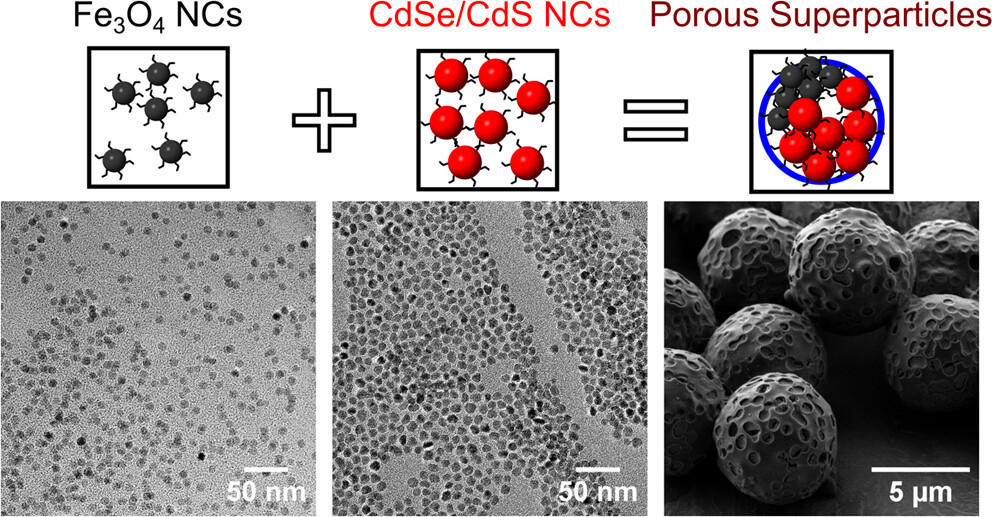
abstract = {Porous superstructures are characterized by a large surface area and efficient molecular transport. Although methods aimed at generating porous superstructures from nanocrystals exist, current state-of-the-art strategies are limited to single-component nanocrystal dispersions. More importantly, such processes afford little control over the size and shape of the pores. Here, we present a new strategy for the nanofabrication of porous magneto-fluorescent nanocrystal superparticles that are well controlled in size and shape. We synthesize these composite superparticles by confining semiconductor and superparamagnetic nanocrystals within oil-in-water droplets generated using microfluidics. The rapid densification of these droplets yields spherical, monodisperse, and porous nanocrystal superparticles. Molecular simulations reveal that the formation of pores throughout the superparticles is linked to repulsion between nanocrystals of different compositions, leading to phase separation during self-assembly. We confirm the presence of nanocrystal phase separation at the single superparticle level by analyzing the changes in the optical and photonic properties of the superstructures as a function of nanocrystal composition. This excellent agreement between experiments and simulations allows us to develop a theory that predicts superparticle porosity from experimentally tunable physical parameters, such as nanocrystal size ratio, stoichiometry, and droplet densification rate. Our combined theoretical, computational, and experimental findings provide a blueprint for designing porous, multifunctional superparticles with immediate applications in catalytic, electrochemical, sensing, and cargo delivery applications.},

keywords = {},

pubstate = {published},

tppubtype = {article}

}
Lee, J; Zhao, T; Yang, S; Muduli, M; Murray, CB; Kagan, CR
One-pot heat-up synthesis of short-wavelength infrared, colloidal InAs quantum dots Journal Article
In: The Journal of Chemical Physics, vol. 160, pp. 071103, 2024.
@article{nokey,

title = {One-pot heat-up synthesis of short-wavelength infrared, colloidal InAs quantum dots},

author = {J Lee and T Zhao and S Yang and M Muduli and CB Murray and CR Kagan},

url = {https://pubs.aip.org/aip/jcp/article/160/7/071103/3266823},

doi = {10.1063/5.0187162},

year  = {2024},

date = {2024-02-21},

urldate = {2024-02-21},

journal = {The Journal of Chemical Physics},

volume = {160},

pages = {071103},

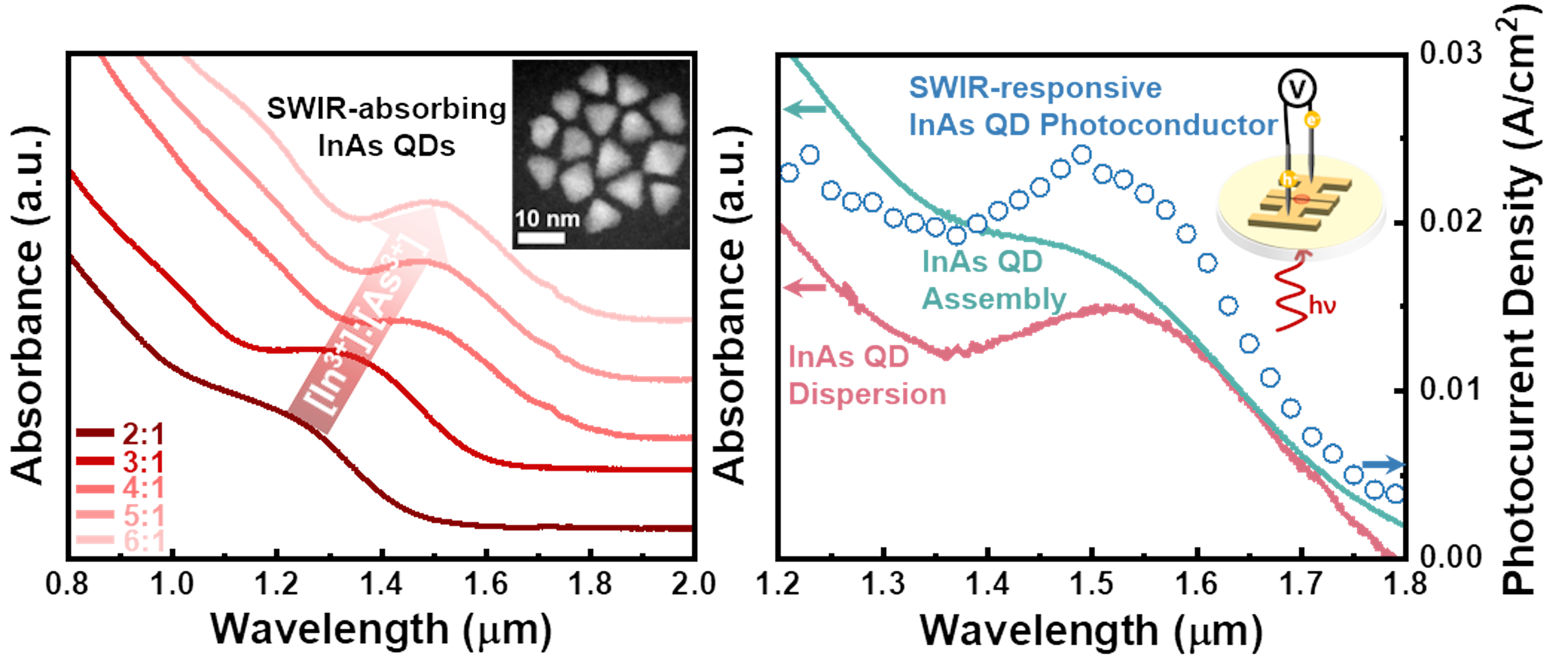
abstract = {III–V colloidal quantum dots (QDs) promise Pb and Hg-free QD compositions with which to build short-wavelength infrared (SWIR) optoelectronic devices. However, their synthesis is limited by the availability of group-V precursors with controllable reactivities to prepare monodisperse, SWIR-absorbing III–V QDs. Here, we report a one-pot heat-up method to synthesize ∼8 nm edge length (∼6.5 nm in height) tetrahedral, SWIR-absorbing InAs QDs by increasing the [In3+]:[As3+] ratio introduced using commercially available InCl3 and AsCl3 precursors and by decreasing the concentration and optimizing the volume of the reducing reagent superhydride to control the concentration of In(0) and As(0) intermediates through QD nucleation and growth. InAs QDs are treated with NOBF4, and their deposited films are exchanged with Na2S to yield n-type InAs QD films. We realize the only colloidal InAs QD photoconductors with responsivity at the technologically important wavelength of 1.55 μm.},

keywords = {},

pubstate = {published},

tppubtype = {article}

}
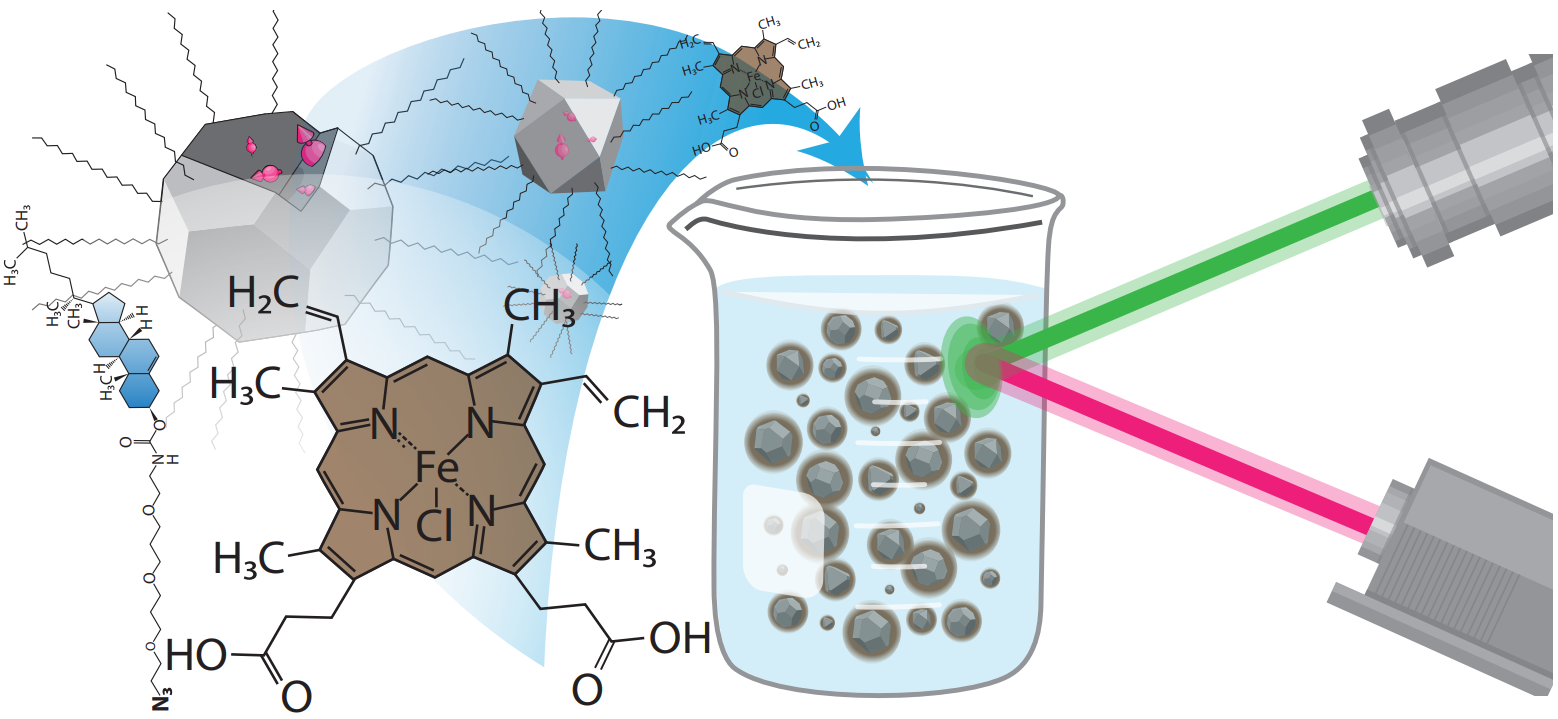
Shulevitz, Henry J.; Amirshaghaghi, Ahmad; Ouellet, Mathieu; Brustoloni, Caroline; Yang, Shengsong; Ng, Jonah J.; Huang, Tzu-Yung; Jishkariani, Davit; Murray, Christopher B.; Tsourkas, Andrew; Kagan, Cherie R.; Bassett, Lee C.
Nanodiamond emulsions for enhanced quantum sensing and click-chemistry conjugation Journal Article Forthcoming
In: Forthcoming.
@article{nokey,

title = {Nanodiamond emulsions for enhanced quantum sensing and click-chemistry conjugation},

author = {Henry J. Shulevitz and Ahmad Amirshaghaghi and Mathieu Ouellet and Caroline Brustoloni and Shengsong Yang and Jonah J. Ng and Tzu-Yung Huang and Davit Jishkariani and Christopher B. Murray and Andrew Tsourkas and Cherie R. Kagan and Lee C. Bassett},

url = {https://arxiv.org/abs/2311.16530},

doi = {10.48550/arXiv.2311.16530},

year  = {2023},

date = {2023-12-04},

urldate = {2023-12-04},

abstract = {Nanodiamonds containing nitrogen-vacancy (NV) centers can serve as colloidal quantum sensors of local fields in biological and chemical environments. However, nanodiamond surfaces are challenging to modify without degrading their colloidal stability or the NV center's optical and spin properties. Here, we report a simple and general method to coat nanodiamonds with a thin emulsion layer that preserves their quantum features, enhances their colloidal stability, and provides functional groups for subsequent crosslinking and click-chemistry conjugation reactions. To demonstrate this technique, we decorate the nanodiamonds with combinations of carboxyl- and azide-terminated amphiphiles that enable conjugation using two different strategies. We study the effect of the emulsion layer on the NV center's spin lifetime, and we quantify the nanodiamonds' chemical sensitivity to paramagnetic ions using T1 relaxometry. This general approach to nanodiamond surface functionalization will enable advances in quantum nanomedicine and biological sensing.},

keywords = {},

pubstate = {forthcoming},

tppubtype = {article}

}
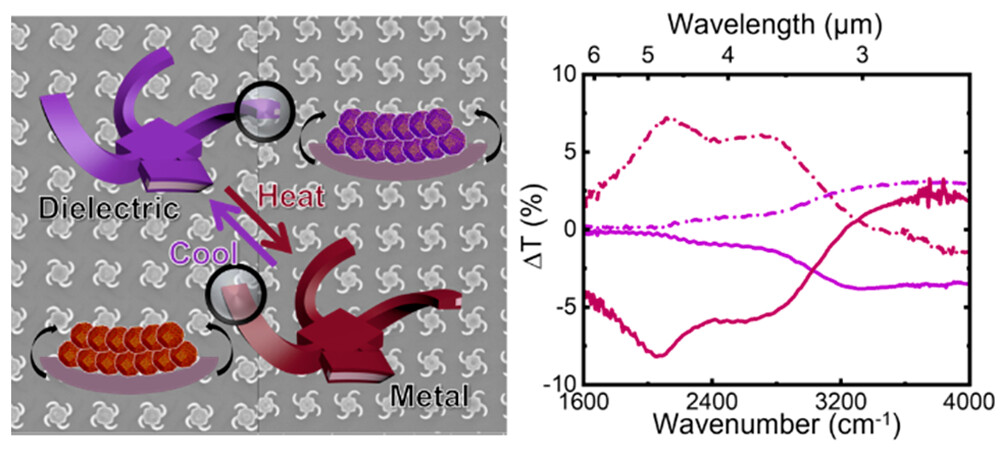
Choi, Yun Chang; Yang, Shengsong; Murray, Christopher B.; Kagan, Cherie R.
Thermally Reconfigurable, 3D Chiral Optical Metamaterials: Building with Colloidal Nanoparticle Assemblies Journal Article
In: ACS Nano, vol. 17, iss. 22, pp. 22611–22619, 2023.
@article{Choi2023b,

title = {Thermally Reconfigurable, 3D Chiral Optical Metamaterials: Building with Colloidal Nanoparticle Assemblies},

author = {Yun Chang Choi and Shengsong Yang and Christopher B. Murray and Cherie R. Kagan},

url = {https://pubs.acs.org/doi/full/10.1021/acsnano.3c06757},

doi = {10.1021/acsnano.3c06757},

year  = {2023},

date = {2023-11-13},

journal = {ACS Nano},

volume = {17},

issue = {22},

pages = {22611–22619},

abstract = {The three-dimensional, geometric handedness of chiral optical metamaterials allows for the rotation of linearly polarized light and creates a differential interaction with right and left circularly polarized light, known as circular dichroism. These three-dimensional metamaterials enable polarization control of optical and spin excitation and detection, and their stimuli-responsive, dynamic switching widens applications in chiral molecular sensing and imaging and spintronics; however, there are few reconfigurable solid-state implementations. Here, we report all-solid-state, thermally reconfigurable chiroptical metamaterials composed of arrays of three-dimensional nanoparticle/metal bilayer heterostructures fabricated from coassemblies of phase change VO2 and metallic Au colloidal nanoparticles and thin films of Ni. These metamaterials show dynamic switching in the mid-infrared as VO2 is thermally cycled through an insulator–metal phase transition. The spectral range of operation is tailored in breadth by controlling the periodicity of the arrays and thus the hybridization of optical modes and in position through the mixing of VO2 and Au nanoparticles.},

keywords = {},

pubstate = {published},

tppubtype = {article}

}
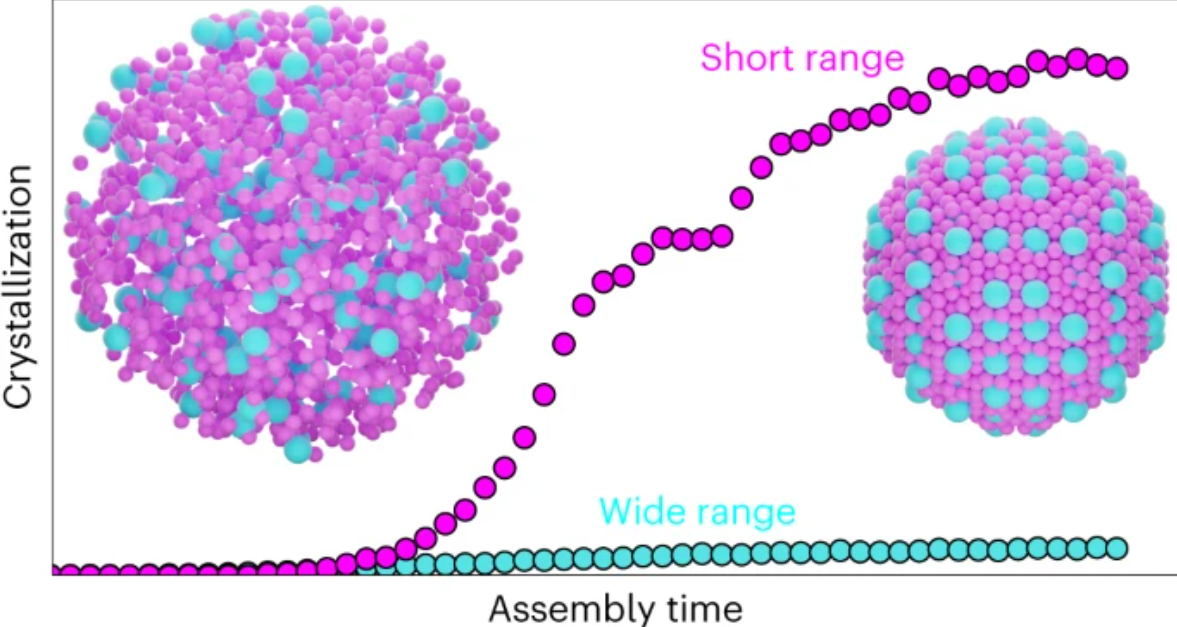
Marino, Emanuele; LaCour, R. Allen; Moore, Timothy C.; van Dongen, Sjoerd W.; Keller, Austin W.; An, Di; Yang, Shengsong; Rosen, Daniel J.; Gouget, Guillaume; Tsai, Esther H. R.; Kagan, Cherie R.; Kodger, Thomas E.; Glotzer, Sharon C.; Murray, Christopher B.
Crystallization of binary nanocrystal superlattices and the relevance of short-range attraction Journal Article
In: Nature Synthesis, 2023.
@article{Marino2023,

title = {Crystallization of binary nanocrystal superlattices and the relevance of short-range attraction},

author = {Emanuele Marino and R. Allen LaCour and Timothy C. Moore and Sjoerd W. van Dongen and Austin W. Keller and Di An and Shengsong Yang and Daniel J. Rosen and Guillaume Gouget and Esther H. R. Tsai and Cherie R. Kagan and Thomas E. Kodger and Sharon C. Glotzer and Christopher B. Murray },

url = {https://doi.org/10.1038/s44160-023-00407-2},

doi = {10.1038/s44160-023-00407-2},

year  = {2023},

date = {2023-10-12},

journal = {Nature Synthesis},

abstract = {The synthesis of binary nanocrystal superlattices (BNSLs) enables the targeted integration of orthogonal physical properties, such as photoluminescence and magnetism, into a single superstructure, unlocking a vast design space for multifunctional materials. However, the formation mechanism of BNSLs remains poorly understood, restricting the prediction of the structure and properties of superlattices. Here we use a combination of in situ scattering and molecular simulation to elucidate the self-assembly of two common BNSLs (AlB2 and NaZn13) through emulsion templating. Our self-assembly experiments reveal that no intermediate structures precede the formation of the final binary phases, indicating that their formation proceeds through classical nucleation. Using simulations, we find that, despite the formation of AlB2 and NaZn13 typically being attributed to entropy, their self-assembly is most consistent with the nanocrystals possessing short-range interparticle attraction, which we find can accelerate nucleation kinetics in BNSLs. We also find homogeneous, classical nucleation in simulations, corroborating our experiments. These results establish a robust correspondence between experiment and theory, paving the way towards prediction of BNSLs.},

keywords = {},

pubstate = {published},

tppubtype = {article}

}