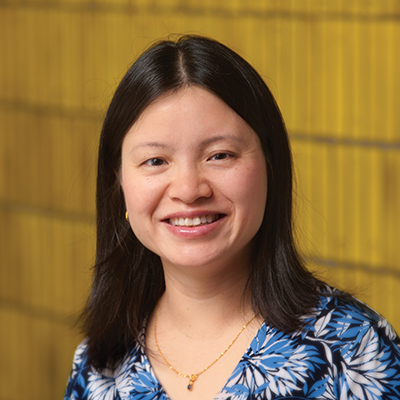
shu yang

Shu Yang


Skirkanich Assistant Professor in Materials Science and Engineering

203 LRSM
898.9645
shuyang@seas.upenn.edu
group page

Ph.D., Chemistry and Chemical Biology, Cornell University, 1999
M.S., Chemistry and Chemical Biology, Cornell University, 1997
B.S., Material Science, Fudan University, China, 1992

Research Interests
Synthesis, characterization and fabrication of functional polymers, and organic/inorganic hybrids. Special interests include preparation of functional block copolymers and investigation of their nanostructures; understanding the self-organization process at surfaces and interfaces; development of novel photosensitive materials and non-conventional approaches for nano- and micropatterning of complex 2D and 3D structures; controlling liquid wetting/dewetting behavior on polymer thin films.

Current Research Projects

Functional Nanostructured Materials. Nanostructured materials exhibit a wide range of unusual characteristics that are observed only on the nanometer length scale. Using functional polymer and hybrid materials as building blocks, we can design complex nanostructures that are technologically important. We are interested in utilizing the self-assembly of block copolymers as a tool and design a library of functional block copolymers to engineer nano-objects and nano-devices. Block copolymers can be used as molecular templates to direct the growth of organosilicates with confined shape, size, composition and functionality. We focus on new design of block copolymers to tailor the polymer-silicates interactions, and polymer and sol-gel surface/interface chemistry to discover novel nano-hybrid materials and their properties. Polymer brushes that have molecular thin layers provide a new venue to engineer the surface and interface properties. By fine-tuning surface chemistry, architectures, molecular conformations, and surface roughness and periodicity, we prepare multifunctional, adaptive and spatially addressable polymer layers.

Non-conventional Nano- and Micropatterning. Advancement in fabrication of two and three dimensional nano- and microstructures plays an important role in the progress of nanotechnology and biotechnology. Our interest is to couple novel design of photosensitive materials and search for non-conventional lithographic techniques to push the limit of nano-/micropatterning, and to build complex 2D and 3D nano- and microstructures with desired shape and properties. Special interests involve multi-beam interference lithography to create periodic 2D and 3D photonic structures; two-photon lithography to introduce arbitrary shapes and sizes; and soft lithography to generate large 3D structures with biological interests. We explore the combination of top-down and bottom- up approaches to create hierarchical structures with a wide range of features from nanometers to micrometers.

Biomimetic Photonic Materials and Systems. Biology provides a multitude of varied, new paradigms for the development of adaptive optical networks. We are interested in learning from natural optical systems, developing bio-inspired synthetic strategies, and application of the learned knowledge to engineer novel photonic materials and devices.

Tunable Wetting on Adaptive and Nanostructured Surfaces. On the order of tens to hundreds of micrometer length scale, liquids wetting behavior is strongly influenced by the surface tension. The ability to dynamically tune surface properties would provide attractive opportunities in many applications, ranging from photonics to biotechnology. We are interested in novel surfaces that will change the wetting behavior in response to electricity, solvent, heat and light.

Selected Publications

[Back to Faculty Page]
[Back to Main MSE Page]